Today’s technological landscape is a hub of growing businesses, eventually reaching a point where its hosting infrastructure, be it the servers, storage, networking, and systems that power its website and applications, becomes a bottleneck rather than a competitive advantage.
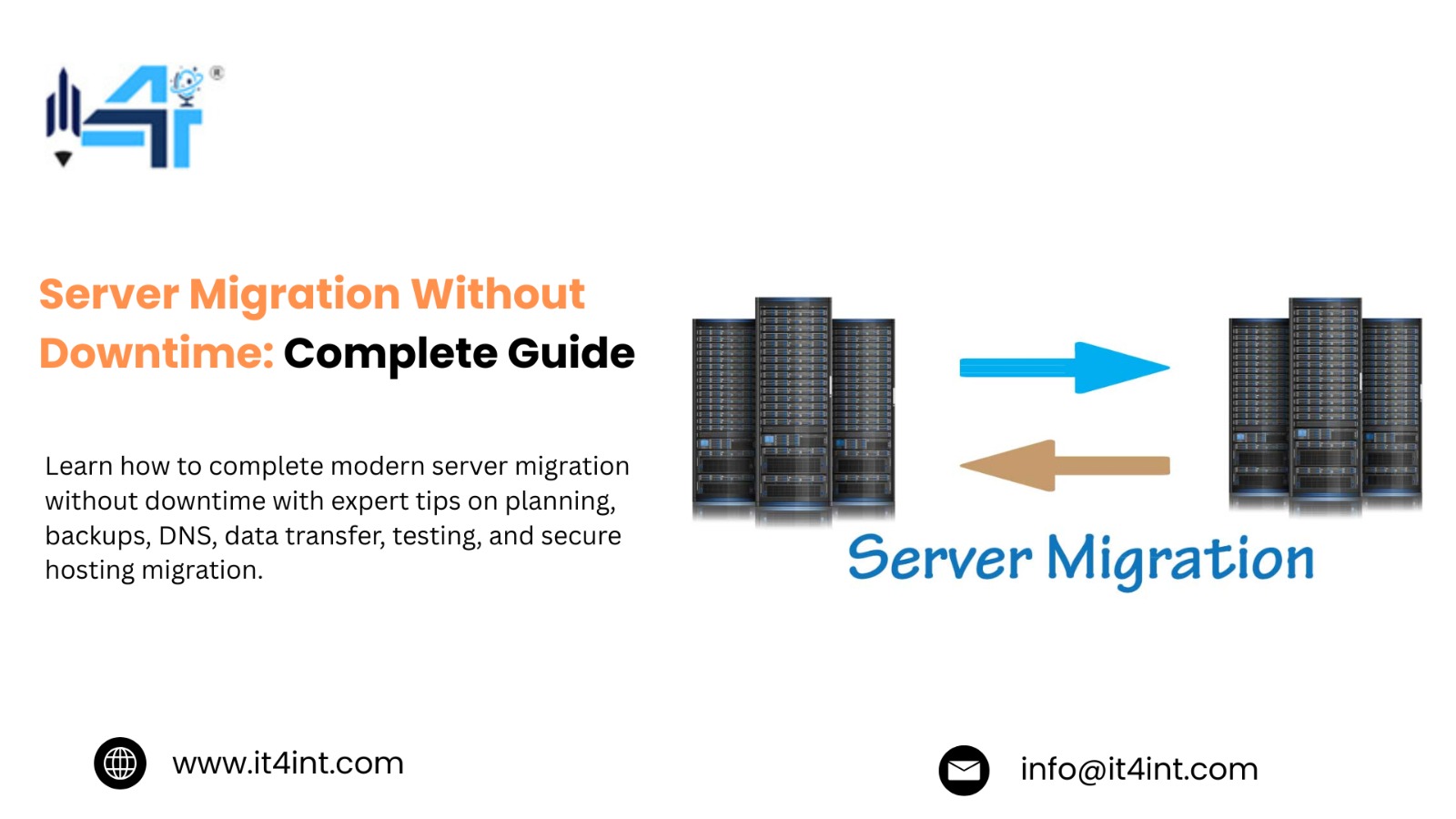
In an era of AI workloads, hybrid cloud adoption, and rising cybersecurity threats, as digital transformation accelerates, businesses are discovering that modern infrastructure is a strategic investment. But can businesses really switch hosting providers without downtime? Yes, and modern server migration providers like iT4iNT carefully plan staged deployment, with DNS optimization and real-time data synchronization through various tests.
Having said that, whether you’re planning a website migration, VPS migration, dedicated server migration, or a broader infrastructure migration, understanding what happens behind the scenes can help you replace uncertainty with confidence. Let’s see how, with the right strategy, the right technology, and the right migration partner, switching hosting providers can become an opportunity for your business to build an infrastructure that’s ready for whatever comes next.
Why are businesses switching hosting providers more than ever?
Before we move on to why businesses switch hosting providers, it is essential to understand who a hosting provider is. It’s essentially a company that supplies the servers, storage, networking, and supporting infrastructure that a business requires to keep the websites, applications, databases, and business systems online and accessible to users all the time.
Be it a small business website, an e-commerce store, a SaaS platform, or an enterprise application, in the early stages, choosing a hosting provider is about affordability, ease of setup, shared hosting, entry-level VPS plans, and enough resources to support their current traffic and workloads. But as your business grows, you attract more visitors, process larger volumes of data, launch new digital services, and adapt to cloud-based applications, the hosting environment becomes a limiting factor.
Here are the major reasons behind businesses switching hosting providers:
- Rising cloud and infrastructure costs
- AI workloads are reshaping infrastructure
- Better performance drives better business outcomes
- Scalability for business growth
- Stronger security and cyber resilience
- Compliance and data governance
- Infrastructure modernisation
- Hybrid cloud adoption
Which brings business to switching hosting providers. But switching hosting providers is about making sure your infrastructure can support the business growth. That’s why enterprise infrastructure providers like iT4iNT focus on helping businesses modernize their infrastructure through carefully planned server migration services that minimize disruption while maximizing long-term performance.
What actually happens during a professional server migration?
Even though you have recognized a need to switch your hosting provider and grow as a business, you are not alone if you hesitate to switch hosting providers because of uncertainty. However, with professional server migration hosting providers like iT4iNT, you get a carefully planned, step-by-step process designed to minimize disruption while protecting your application, data, and business operations.
Having said that, every modern server migration differs depending on the size and complexity of the environment. Here’s a step-by-step framework that most professional hosting migration projects follow:
- STEP 1: Infrastructure Assessment and Migration Planning
- STEP 2: Full backup and disaster recovery preparation
- STEP 3: Building the new hosting environment
- STEP 4: Secure data migration and synchronisation
- STEP 5: Comprehensive testing before go-live
- STEP 6: DNS optimisation and final cutover
- STEP 8: Rollback planning
Along with creating verified backups and recovery points, the iT4iNT team continuously monitors your infrastructure health and stability, along with maintaining a fallback plan until migration is fully validated. This means businesses can confidently switch hosting providers, modernize their infrastructure, and achieve a migration without downtime, along with preserving website SEO, data integrity, and business continuity.
Website Migration vs Server Migration vs Cloud Migration
If you are a business planning to modernize your infrastructure, one of the biggest misconceptions is migrating everything. Whereas segregation-like website migration, server migration, and cloud migration aim at solving different business challenges by providing varied scope, complexity, and business outcome solutions.
Having said that, at iT4iNT, server migration is not a one-size-fits-all process; rather, every migration strategy is aligned to the applications, workloads, security needs, and long-term objectives of your unique business.
Here’s a comparison table for you:
| Migration Type | What Moves? | Best For | Typical Business Goal |
| Website Migration | Website files, CMS, databases, media, DNS, SSL | Blogs, business websites, eCommerce stores | Improve website performance, redesign, change hosting providers, preserve SEO |
| Server Migration | Entire server environment, applications, databases, operating systems, networking, storage | Growing businesses, SaaS platforms, and enterprise applications | Modernize infrastructure, improve performance, increase security, and scalability |
| Cloud Migration | Applications, workloads, databases, virtual machines, services | Organizations adopting cloud or hybrid infrastructure | Improve flexibility, scalability, disaster recovery, and global accessibility |
Moreover, iT4iNT helps businesses build migration roadmaps that align technology decisions with long-term business goals like dedicated servers, VPS hosting, GPU servers, hybrid cloud, disaster recovery, and bare metal infrastructure so that you can choose confidently to execute the right migration path while making sure your technology continues to drive innovation rather than limit it.
Why do businesses choose managed migration services?
The straightforward answer is that a professionally managed migration reduces operational risk, minimizes downtime, protects business-critical data, and ensures every component is carefully validated before users are redirected to the new environment.
Moreover, modern server migration projects often involve complex environments, which comprise websites, applications, databases, virtual machines, cloud services, security configurations, email systems, APIs, and third-party integration.
Here’s why businesses prefer managed migration services:
- Reduced operational risk
- Minimal or zero downtime
- Protection against data loss
- Access to experienced infrastructure specialists
- Post-migration support and monitoring
- Tailored migration strategies
Additionally, a professional server migration follows a structured methodology, helping businesses transition smoothly into modern infrastructure.
Conclusion
In conclusion, a server migration is no longer just an IT project but rather a strategic business decision that determines how your business will scale, innovate, and compete in an increasingly digital world.
Hence, iT4iNT makes migration more than moving workloads from one server to another; rather, it is about understanding your business objectives, designing the right infrastructure strategy, and making sure that every transition is secure, seamless, and built for long-term success.
FAQs
Does switching hosting providers cause downtime?
No, if you are taking service from professional modern server migration providers like iT4iNT, as they use extensive pre-migration testing to make sure businesses can switch hosting providers with a seamless user experience.
How long does a server migration take?
The tile depends on the size and complexity of your infrastructure. Where small websites may be migrated within a few hours, enterprise environments involve multiple servers.
Will migration hosting providers hurt my SEO rankings?
No, if the migration is performed correctly, a managed website migration preserves SEO by maintaining URL structure and minimizing downtime so that your search engine can continue crawling your website without interruption.
Visit – Dedicated Server USA, Dedicated Server India, Dedicated Server France, Dedicated Server Japan, Dedicated Server Italy, Dedicated Server UAE, Dedicated Server Spain, Dedicated Server Turkey