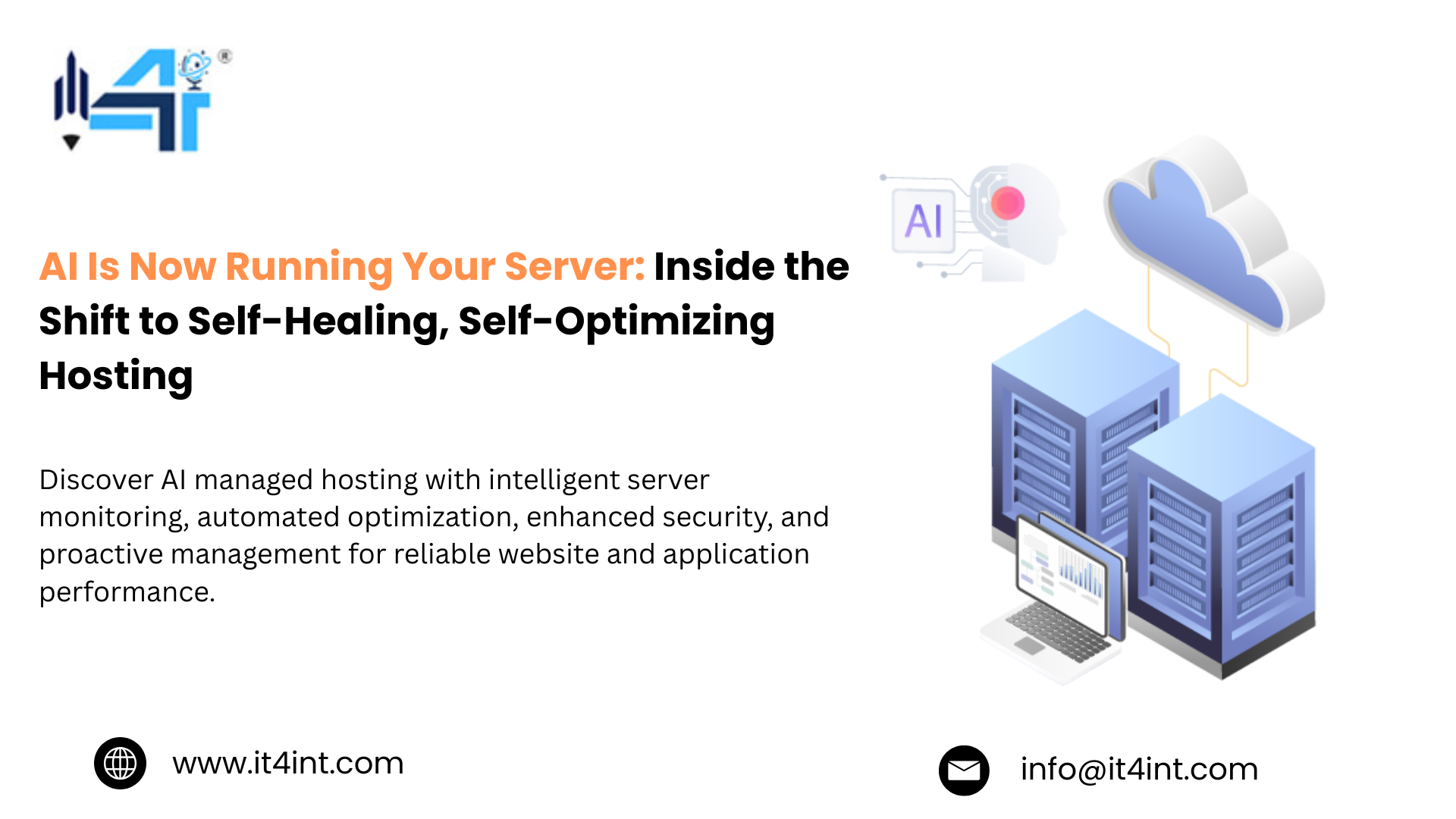
What if your server could spot trouble before you did? That question is becoming increasingly practical as AI-managed hosting 2026, and IT4iNT Servers bring predictive monitoring, automated remediation, and autonomous operations into the hosting conversation.
The whole idea of a server that quietly watches its own health, spots unusual behavior, reroutes traffic, restarts failing services, or scales capacity no longer belongs purely in a futuristic roadmap. This is known as the rise of self-healing hosting, and it is changing how modern businesses should expect from their infrastructure providers. While server management focused on something broken, monitoring generated an alert, an engineer investigated the case, and someone manually applied the fix. But today’s environments are different, with microservices, distributed workloads, cloud infrastructure, edge systems, and constantly shifting traffic patterns to create more operational signals that human teams can realistically process.
Having said that, AI managed hosting infrastructure approaches the problem differently, where instead of simply telling engineers that something is wrong, modern AIOps platforms can correlate telemetry, identify patterns, prioritize incidents, recommend actions, and, within defined boundaries, execute remediation automatically. For iT4iNT Servers, we explain how and why the old DevOps model is under pressure, where autonomous operations are genuinely delivering value, and what you as a business should look for while choosing a hosting provider in 2026.
What does “AI-managed hosting” mean?
Before we move on to understanding the shift to self-healing and self-optimizing hosting, it is essential to understand what AI-managed hosting actually means. Primarily, AI-managed hosting is a hosting model where AI helps in monitoring, analyzing, optimizing, and responding to infrastructure events with minimal manual intervention.
So instead of depending completely on engineers to watch dashboards and react when something breaks, AI systems continuously analyze your server health, application behavior, traffic patterns, logs, and other operational signals to identify problems and take corrective actions automatically. In short, AI-managed hosting moves towards “detect, understand, act, and verify.” As modern infrastructure generates a large amount of operational data, AI-managed hosting generally operates across several connected capabilities like AI infrastructure monitoring, predictive monitoring, autonomous server management, predictive traffic scaling, automated remediation, and agentic infrastructure operations for handling repetitive monitoring, detection, triage, and lower-risk remediation, which makes AI managed hosting better understood as an operational strategy for dealing with dynamic, distributed, and data-heavy environments for traditional monitoring alone.
Why couldn’t the old DevOps model keep up?
There is no secret in the fact that DevOps has transformed how teams build and operate software; however, the underlying infrastructure behind modern applications has changed faster than the operating model itself. So what once meant managing a relatively predictable collection of servers, including distributed workloads, microservices, cloud platforms, containers, APIs, edge infrastructure, and constantly changing traffic patterns.
While the traditional workflow goes from something happening, monitoring raises an alert, and an engineer investigates, to someone fixing it. However, some models still work for many incidents, but here’s why the old DevOps model couldn’t keep up with the modern infrastructure:
- Complexity multiplied faster than headcount
- Alert fatigue became a reliability issue
- Reactive monitoring has a build-in limitation
- Human response introduces unavoidable latency
- Repetitive fixes consume expert attention
Moreover, this is an environment where AI-managed hosting becomes useful, where AI can process operational signals continuously and at machine speed, while autonomous server management takes that idea further by allowing predictive traffic scaling to start moving from human-operated systems toward human-supervised autonomous operations.
The result behind the shift to autonomous operations
Autonomous operations are reducing the amount of time infrastructure spends waiting for someone to notice, understand, and respond to a problem. Especially with AI-managed hosting, monitoring becomes more than a passive layer that raises alarms of an active operational loop that can detect patterns, investigate signals, initiate approved action, and verify whether the system has recovered.
With a shift from manual to autonomous operations, the results behind practical impact are the following:
- Detection happens continuously
- Triage becomes faster
- Remediation can happen automatically
- Traffic can be anticipated
- Verification closes the loop
- Human escalation becomes more targeted
While this changes the role of your operations team, early industry results cited in the supplied research indicated that mature AIOps and self-healing deployments can deliver substantial reductions in MTTR and alert volumes.
What do autonomous operations mean for your hosting choice?
If you are selecting a hosting provider in 2026 like iT4iNT Servers, autonomous operations should be more than just a checkbox labeled “AI-powered.” So, can your hosting provider detect an anomaly before it becomes an outage, and can it verify that the fix worked?
These questions matter, as AI-managed hosting is a range of operational capabilities. So while comparing hosting providers, here are a few things that you must look into:
- Does the provider offer AI infrastructure monitoring?
- Can the infrastructure remediate problems automatically?
- How does the provider handle traffic spikes?
- What is the real MTTR?
- How much human intervention is normally required?
- What happens when AI is uncertain?
- Can you see evidence rather than promises?
Knowing these answers would not only allow you to understand the operational transparency but also give you insight into if the hosting provider can demonstrate useful autonomy, measurable outcomes, and controlled human oversight or not.
Frequently Asked Questions:
Is AI-managed hosting the same as fully automated hosting with no human involvement?
Not quite. Most production deployments today use AI to handle the repetitive, high-volume work of detection, triage, and common fixes while humans stay involved for complex or high-stakes decisions. Full autonomy exists but is still the exception, not the norm.
Will AI-managed infrastructure actually reduce my downtime?
The data suggests yes, meaningfully; organizations using AI-driven incident response commonly report large cuts to both detection and resolution time, which directly translates to less time spent offline or degraded.
How do I know if a hosting provider’s “AI-powered” claims are real?
Ask for the specific mechanism of predictive monitoring, automated remediation, or agentic response, and ask what’s actually measured (MTTR, alert reduction). Vague “AI-powered” language with no metrics behind it is a reasonable reason to ask more questions.
Visit – Dedicated Server USA, Dedicated Server India, Dedicated Server France, Dedicated Server Japan, Dedicated Server Italy, Dedicated Server UAE, Dedicated Server Spain, Dedicated Server Turkey