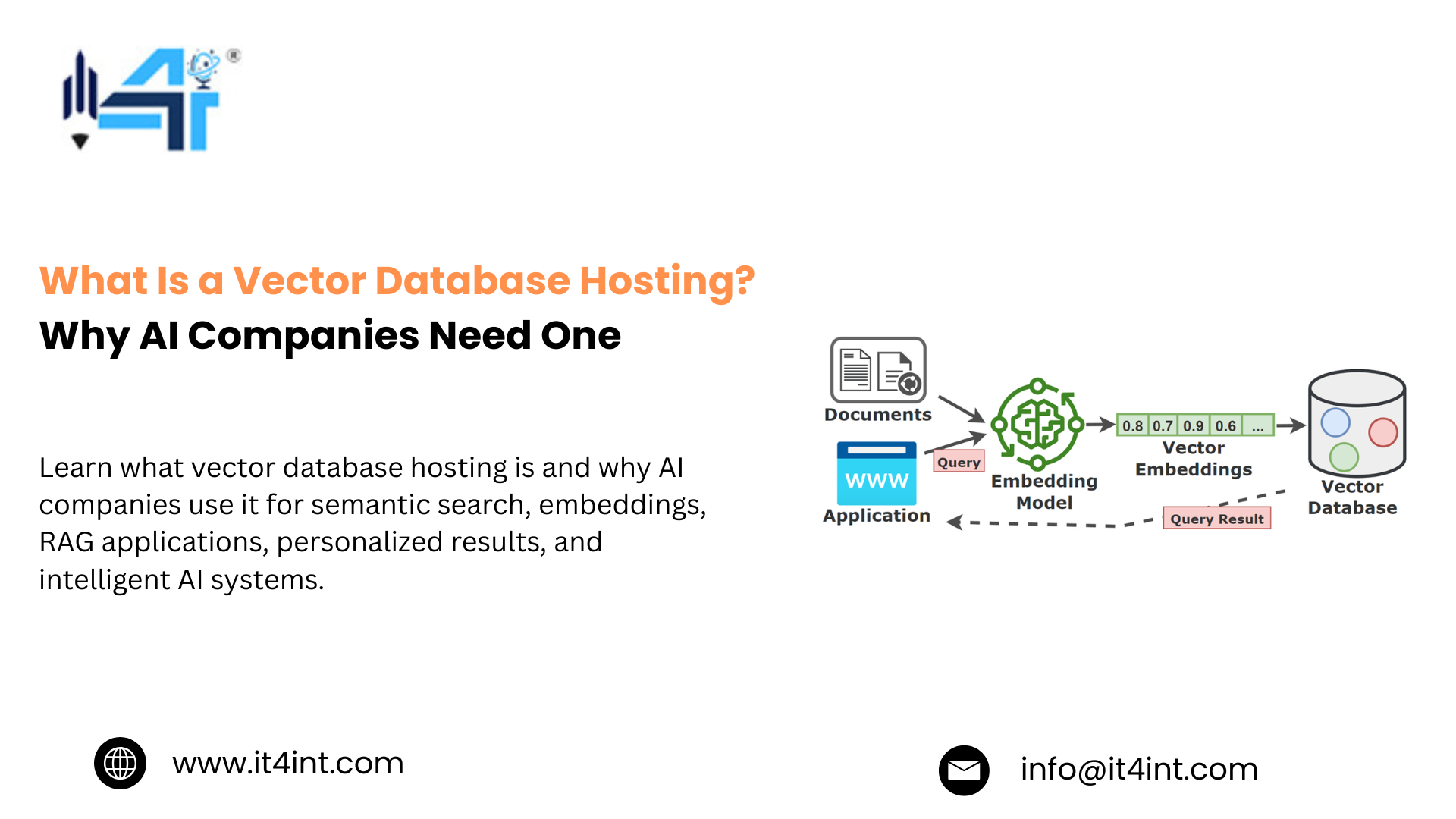
As the technological landscape evolves, vector database hosting is quickly becoming a core infrastructure decision for AI companies, and IT4iNT Servers helps businesses build the low-latency, scalable foundations needed to make their AI applications more useful, accurate, and responsive.
Even though for years the AI conversation focused on models, which were bigger, faster, smarter, or cheaper, in 2026, the competitive advantage has shifted towards one major limitation of the model: not automatically knowing your latest product documentation, internal policies, customer records, research, or business processes. This is the exact challenge driving the ongoing adoption of vector databases, which enable AI systems to search by semantic similarity, turning structured information into knowledge that can be retrieved and used in real time. As RAG architectures, multimodal AI, and autonomous agents become more common, the infrastructure behind vector search will matter as much as the models themselves.
However, this hosting environment influences how quickly information can be retrieved, how reliably the system performs under load, where sensitive data is stored, and how easily the infrastructure can grow with demand. In 2026, undertaking how they work and how to host the iT4iNT servers effectively across industries.
What is a vector database?
Before we move on to understanding why every AI company suddenly needs a vector database, it is essential to know what exactly vector database hosting is. Primarily, a vector database is a database that is built to help AI understand meaning instead of simply matching words. Contrary to traditional databases that retrieve information based on exact values or keywords, a vector database stores data as vector embeddings, which are high-dimensional numerical representations that are generated by AI models that capture the semantic meaning of text, images, audio, videos, and even code.
This allows AI systems to find conceptually similar information, even when the wording is completely different. Here’s why vector database hosting is becoming foundational:
- They make semantic search practical at enterprise scale
- They improve AI accuracy by retaining relevant context
- They enable retrieval-augmented generation (RAG).
- They support multimodal AI beyond just text
- They reduce latency for real-time AI experiences
- They help organisations unlock value from unstructured data
In addition to this, what iT4iNT Servers believes is that as AI becomes increasingly multimodal and businesses’ knowledge continues to grow, vector database hosting is growing into a fundamental infrastructure layer that connects language models with real-world information.
Why do traditional databases struggle with AI search?
While traditional databases were built for a world where data was highly structured and queries were predictable, AI does not work that way. People rarely ask questions using exact words found in a document. No doubt that they use natural language, incomplete thoughts, synonyms, abbreviations, and conversational phrasing; an AI assistant needs to understand that reduce cloud costs, cut infrastructure spending, and optimize hosting experience are asking about the same concept.
Here’s why traditional databases are not designed to understand semantic relationships:
- Searched literal words instead of concepts
- Missed documents that use different terminology
- Cannot understand synonyms or user intent
- Relies heavily on manually created indexes and metadata
- Doesn’t scale well for semantic AI workloads
- Creates poor user experiences in AI assistants and business search
This is the reason why modern AI architectures replace relational databases; instead, they extend them with vector databases, allowing businesses to preserve transactional integrity while adding intelligent semantic retrieval for AI-powered applications.
Why does a RAG system depend on vector databases?
Retrieval-Augmented Generation (RAG) stands as the architecture behind many of today’s most reliable AI applications, which solves the biggest limitation of large language models. While a model can have impressive reasoning capabilities, it cannot answer questions about your internal documentation, product manuals, customer records, compliance policies, or proprietary research unless that information is retrieved and provided as context.
Why vector databases are the foundation of RAG is because
- Understand the intent behind user questions
- Search enterprise knowledge by meaning instead of exact wording
- Retrieve the most relevant documents in milliseconds
- Feed accurate context into a language model
- Keep responses aligned with the latest company information
- Improve trust, accuracy, and user confidence
What we IT4iNT Servers urge modern businesses to do is to evolve into autonomous agents capable of reasoning, planning, and executing tasks; high-quality retrieval becomes even more important. Additionally, vector databases provide the speed, scalability, and semantic understanding that not only allow RAG architecture to operate effectively in production environments but also provide access to the knowledge that AI depends on.
The next step in your AI journey
As AI grows to be knowledge-driven, investing in the right vector database hosting strategy makes sure that your business remains fast, accurate, and scalable. With iT4iNT Server, you can build a secure, high-performance infrastructure that is ready for next generation of RAG, AI agents, and enterprise.
Frequently Asked Questions:
Is a vector database the same as a regular database?
No. A traditional database finds exact matches (specific rows, specific keywords). A vector database finds content that’s similar in meaning, even when the wording is completely different, which is what makes semantic and AI-powered search possible.
Do I need a vector database to use AI in my business?
Not for every AI use case, but yes, if you want the AI to answer accurately using your own company’s documents, policies, or data, that’s what Retrieval-Augmented Generation (RAG) requires, and a vector database is the component that makes RAG work.
Can I add vector search to a database I already use?
In many cases, yes, several established databases, including PostgreSQL, now offer vector search extensions. Whether that’s the right call versus a dedicated vector database depends on your scale and query performance needs.
Where should a vector database be hosted?
As close as possible to the application calling it, since every query adds latency directly to the user’s wait time and, for regulated data, is hosted in a location that satisfies your data residency requirements.
Visit – Dedicated Server USA, Dedicated Server India, Dedicated Server France, Dedicated Server Japan, Dedicated Server Italy, Dedicated Server UAE, Dedicated Server Spain, Dedicated Server Turkey