Introduction
Businesses today generate more data than ever before. From connected devices and industrial sensors to customer applications, enterprise software, and real-time analytics, organisations need reliable ways to process, store, and manage this information. Choosing the right computing infrastructure has become an important part of improving operational efficiency, supporting digital transformation, and staying competitive.
Two technologies that play a significant role in modern IT infrastructure are edge computing and cloud computing. Both enable businesses to access computing resources without relying entirely on traditional, on-premises IT environments. However, they work differently and serve different purposes.
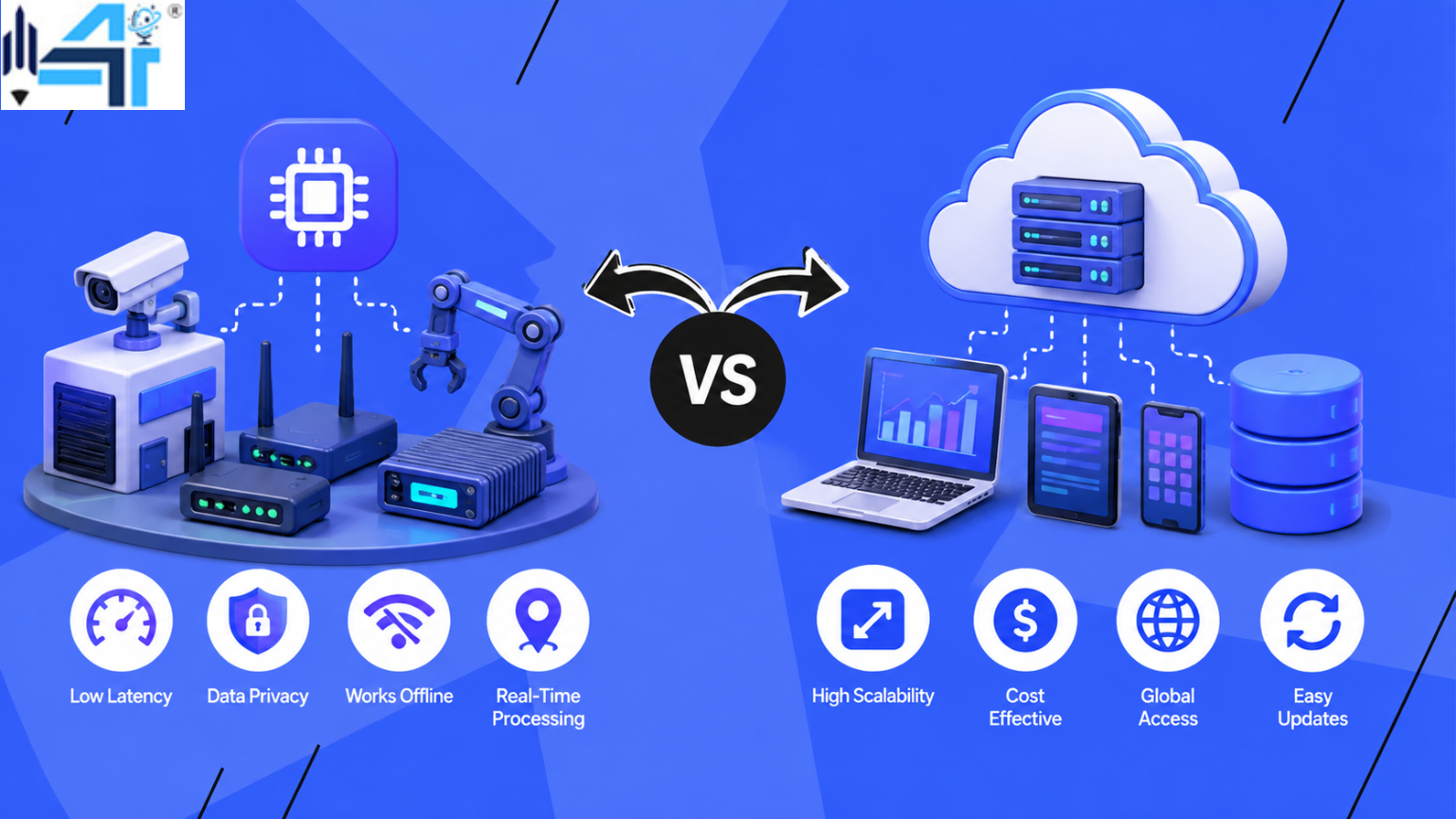
Cloud computing provides access to computing power, storage, databases, and software through remote infrastructure, often managed by a third-party provider. Edge computing processes data closer to where it is generated, helping applications respond quickly and reducing the need to transfer every piece of information to a distant data centre.
So, when comparing edge vs cloud, which approach should your business choose?
The answer depends on your applications, performance requirements, data volumes, security needs, budget, and long-term growth plans. In many cases, the most effective strategy is not choosing one over the other but combining both technologies into a hybrid edge cloud environment.
In this guide, we explain the differences between edge computing and cloud computing, explore their benefits and practical applications, and help you determine which approach best fits your business needs.
What Is Cloud Computing?
Cloud computing is a technology model that allows businesses to access computing resources over a network, typically the internet, instead of purchasing and maintaining all the required infrastructure themselves.
These resources can include servers, storage, databases, networking, analytics platforms, development environments, and business applications. Cloud services are commonly delivered through providers that manage the underlying infrastructure and offer different pricing, capacity, and service options.
One of the biggest advantages of cloud computing is flexibility. Businesses can increase or decrease computing resources as their requirements change without necessarily investing in additional physical servers.
For example, an e-commerce company can scale its cloud resources during seasonal sales, while a growing organisation can use cloud-based applications to support employees across multiple offices.
Key Benefits of Cloud Computing
Scalability: Businesses can expand computing capacity as workloads increase and reduce resources when demand falls.
Cost flexibility: Cloud services often use subscription-based or consumption-based pricing, reducing the need for large upfront infrastructure investments. However, costs depend on usage, licensing, data transfer, and service configuration.
Centralised data management: Organisations can store, analyse, and manage information across multiple locations using shared cloud platforms.
Access to advanced technologies: Cloud environments can provide access to artificial intelligence, machine learning, analytics, automation, and managed database services.
Simplified infrastructure management: Depending on the service model, providers manage much of the underlying hardware, maintenance, and infrastructure operations.
Cloud computing is particularly useful for applications that need substantial computing capacity, centralised collaboration, flexible storage, or access from geographically distributed teams.
However, cloud-based applications may depend on network connectivity and can experience delays when data must travel between local devices and remote infrastructure.
What Is Edge Computing?
Edge computing is a distributed computing approach in which data is processed closer to its source rather than sending everything to a centralised cloud environment.
The processing may happen on industrial computers, local servers, network gateways, smart devices, or edge data centres. These systems can analyse information locally and send only the necessary results, alerts, or selected datasets to central platforms.
This approach is especially valuable when applications require fast responses, operate in locations with limited connectivity, or generate large amounts of data that would be inefficient to transfer continuously.
For example, a manufacturing facility may use edge computing to analyse sensor readings and detect equipment abnormalities in near real time. Instead of sending every reading to a remote cloud platform before taking action, a local system can identify potential problems and trigger an immediate alert.
Key Edge Computing Benefits
Lower latency: Processing data close to its source can reduce the time needed for applications to receive results and respond.
Reduced network traffic: Local filtering and analysis can limit the volume of data transmitted to central infrastructure.
Improved operational continuity: Properly designed edge systems can continue supporting selected local functions during temporary interruptions to external connectivity.
Greater control over local data: Organisations can process sensitive or operational information locally when appropriate, while applying suitable security and governance controls.
Support for real-time applications: Edge infrastructure can help systems respond quickly to changes in industrial processes, connected devices, and local operating conditions.
These edge computing benefits make the technology useful for manufacturing, telecommunications, retail, transportation, and other industries where proximity to data matters.
It is important to note that edge computing does not eliminate the need for central infrastructure. Local devices still require management, security updates, monitoring, and integration with wider business systems.
Edge vs Cloud: What Are the Main Differences?
Although edge computing and cloud computing both support modern digital operations, their architectures differ in several important ways.
| Factor | Edge Computing | Cloud Computing |
| Data processing | Near the data source | Usually in remote data centres |
| Latency | Often lower for local processing | Depends on connectivity and service location |
| Scalability | Expanded across edge devices and sites | Often highly scalable through provider resources |
| Connectivity | Can support selected local functions offline | Many services depend on network connectivity |
| Data handling | Useful for local filtering and analysis | Useful for centralised storage and large-scale analysis |
| Management | May involve many distributed locations | Often centrally managed through provider platforms |
| Cost considerations | Hardware, site maintenance, and deployment costs | Usage, subscription, storage, and transfer costs |
| Common applications | Industrial control support, local analytics, IoT | Enterprise applications, backups, data analytics, collaboration |
Neither technology is universally better. Cloud computing is often well suited to centralised processing and elastic capacity, while edge computing is useful when proximity, response time, or local operation is important.
Dedicated Server Plans
Power your growing business with IT4INT reliable infrastructure built for demanding workloads, with high performance, advanced security, and flexible configurations tailored to your needs.
Latency: Why It Matters for Business Applications
Latency refers to the delay between an action or data transmission and the corresponding response. Even small delays can affect applications that depend on timely information.
For ordinary business tasks, such as updating documents or processing routine reports, a short network delay may have little practical impact. For applications that monitor industrial machinery, analyse production-line images, or coordinate time-sensitive operations, response time can be much more important.
This is where edge computing becomes particularly valuable.
When Edge Computing Is the Better Choice
Latency sensitive applications often benefit from processing resources located close to the devices or systems generating data.
Consider a production facility that uses cameras to identify defective products. If every image must travel to a distant cloud platform before a decision is made, network delays and connectivity problems may affect the workflow. Local processing can help identify defects and notify the relevant system more quickly.
Similar requirements can arise in robotics, traffic monitoring, connected infrastructure, and industrial IoT environments.
However, edge computing does not automatically guarantee a particular response time. Application design, processor performance, network configuration, and system integration all influence actual latency.
When Cloud Computing Is Sufficient
Many business applications do not require immediate local responses. Examples include long-term data analysis, employee collaboration tools, centralised reporting, customer relationship management, and historical sales analysis.
For these workloads, cloud computing may provide the necessary performance while simplifying infrastructure management and supporting collaboration across locations.
Businesses should identify actual application latency requirements before investing in specialised edge infrastructure.
Edge Computing Use Cases Across Different Industries
Understanding practical edge computing use cases can help organisations determine where local processing delivers meaningful value.
1. Manufacturing and Industrial Automation
Manufacturing environments generate data through sensors, industrial machinery, cameras, and production systems. Edge computing can analyse this information locally to support condition monitoring, quality inspection, and predictive maintenance.
For example, an edge system can detect unusual vibration patterns in machinery and notify maintenance teams before a minor issue develops into a larger operational problem.
Cloud platforms can complement this process by collecting historical information from multiple factories and supporting long-term analytics, reporting, and machine-learning model development.
2. Retail and Customer Experience
Retail businesses can use edge computing to support local point-of-sale operations, inventory tracking, video analytics, and in-store monitoring.
Local processing can reduce dependence on continuous communication with remote systems for selected functions. This can be useful in stores with unreliable connectivity or applications that require quick responses.
Cloud computing remains valuable for combining sales information across branches, managing product catalogues, and analysing customer purchasing trends.
3. Healthcare and Medical Facilities
Hospitals and diagnostic centres may use edge infrastructure to support medical imaging workflows, connected equipment, local data processing, and facility monitoring.
Processing selected data locally can help applications respond efficiently and reduce unnecessary data transfers. However, healthcare deployments must meet applicable privacy, security, clinical safety, and regulatory requirements.
Cloud infrastructure can complement local systems by supporting authorised data sharing, centralised analytics, and broader collaboration where appropriate.
4. Telecommunications and Network Services
Telecommunications operators manage distributed networks and services that must support large numbers of connected users and devices.
Edge computing can place processing resources closer to network users, supporting selected low-latency services, local content delivery, and distributed network functions.
Cloud infrastructure can provide additional capacity for centralised management, analytics, and service orchestration.
5. Smart Cities and Transportation
Smart city systems can generate large volumes of data through traffic cameras, environmental sensors, connected infrastructure, and transport networks.
Edge computing can analyse selected information locally to support traffic monitoring, incident detection, and time-sensitive alerts. Sending only relevant information to central systems can also reduce unnecessary network traffic.
Cloud platforms can then combine information from multiple locations for planning, reporting, and long-term analysis.
These examples show that edge computing is most useful when processing location, response time, or data transfer requirements justify distributing computing resources closer to operations.
What Is Hybrid Edge Cloud Computing?
For many organisations, the choice between edge and cloud is not an either-or decision. A hybrid edge cloud architecture combines local processing with centralised cloud resources so that each workload runs where it makes the most sense.
In this model, edge systems handle tasks that benefit from fast local responses, while cloud platforms provide centralised storage, broader analytics, application hosting, and coordination across multiple sites.
For example, a manufacturing company may process sensor readings at the factory edge, store selected operational records in the cloud, and analyse data from several factories through a central analytics platform.
This arrangement allows the business to benefit from local responsiveness without losing the scalability and central visibility offered by cloud computing.
Key Benefits of a Hybrid Edge Cloud Approach
Better workload placement: Applications can run locally or centrally according to their performance and resource requirements.
More efficient data transfer: Edge systems can filter or aggregate information before transmitting it to the cloud.
Centralised visibility: IT teams can use cloud-based tools to monitor and manage distributed edge environments.
Flexible scaling: Businesses can expand cloud capacity while deploying local infrastructure only where operational needs justify it.
Improved resilience: Selected applications can continue performing local functions during connectivity interruptions, provided their architecture and data dependencies support offline operation.
Successful hybrid deployments require careful planning. Businesses must establish consistent security policies, data synchronisation processes, monitoring practices, and application deployment procedures across both environments.
Cost Comparison: Edge Computing vs Cloud Computing
Cost is an important consideration when choosing between edge computing and cloud computing. However, comparing only the initial hardware price or monthly cloud bill can lead to an incomplete decision.
Cloud computing can reduce upfront infrastructure expenditure because businesses can use provider-managed resources instead of purchasing all their own servers. Nevertheless, ongoing costs may include compute usage, storage, licensing, data transfer, and support.
Edge computing may require investment in local servers, networking equipment, power protection, cooling, physical security, and ongoing maintenance. Distributed sites can also increase installation and support complexity.
On the other hand, local processing may reduce network bandwidth costs and the volume of data transmitted to cloud platforms.
The best approach is to evaluate total cost of ownership across the expected operating period.
Businesses should consider:
- Initial hardware and deployment expenses.
- Cloud service subscriptions and usage charges.
- Network connectivity and data transfer costs.
- Power, cooling, and physical space.
- Software licensing and integration.
- Remote monitoring, maintenance, and technical support.
- Security, backup, and disaster recovery.
- Future expansion and equipment replacement.
A practical assessment should compare the full cost of running each workload in different environments rather than assuming that either edge or cloud is always cheaper.
Security and Data Management Considerations
Security should be part of the decision from the beginning, regardless of whether workloads run at the edge, in the cloud, or across both environments.
Cloud providers typically offer security capabilities such as identity management, encryption options, monitoring, and access controls. However, customers still need to configure services correctly and manage their own applications, identities, data, and permissions according to the service model.
Edge environments introduce additional considerations because infrastructure may be distributed across numerous physical locations. Devices can be exposed to environmental risks, unauthorised physical access, inconsistent patching, or limited local supervision.
Businesses should implement appropriate measures, including:
- Strong identity and access management.
- Encryption for sensitive data in transit and at rest.
- Network segmentation and secure device communication.
- Regular software and firmware updates.
- Centralised monitoring and security alerting.
- Backup, recovery, and incident response procedures.
- Defined policies for data retention and cross-location transfers.
For hybrid edge cloud deployments, security controls should remain consistent across both environments wherever practical.
Data residency, industry regulations, customer contracts, and internal governance requirements may also influence where information can be stored or processed. Organisations should evaluate these requirements before finalising their architecture.
How to Choose the Right Computing Model for Your Business
Selecting the right model begins with understanding what your applications need to achieve.
Step 1: Identify Your Workloads
List the applications you plan to run and classify them according to processing requirements, data volumes, availability expectations, and business importance.
Applications requiring immediate local responses may benefit from edge computing. Workloads involving large-scale analytics, shared enterprise applications, or elastic computing capacity may be better suited to the cloud.
Step 2: Evaluate Connectivity
Consider the reliability and performance of the network at each operating location.
If applications must continue performing selected functions during internet outages, local processing may be necessary. If reliable connectivity is available and response-time requirements are flexible, cloud services may be sufficient.
Step 3: Assess Data Volumes
Determine how much information your devices and applications generate.
When continuous data transfer is expensive or impractical, edge systems can filter and aggregate information locally before sending relevant records to central platforms.
Step 4: Define Security Requirements
Review data sensitivity, access policies, regulatory obligations, and physical security considerations.
Choose an architecture that supports your organisation’s governance requirements without introducing unnecessary complexity.
Step 5: Calculate Total Cost of Ownership
Compare infrastructure, connectivity, energy, support, licensing, and maintenance costs. Include expected growth and the cost of managing distributed locations.
Step 6: Plan for Future Growth
Consider whether your applications will require more computing power, storage, or locations over time.
A flexible architecture can help you expand cloud resources, add edge sites, or adopt a hybrid model as your needs evolve.
Step 7: Test Before Scaling
Start with a pilot project where possible. Measure response times, application performance, operational costs, reliability, and management requirements.
Use the results to refine your architecture before deploying it across the wider business.
Common Mistakes to Avoid
Businesses can make several mistakes when evaluating edge computing and cloud computing.
Choosing technology before identifying the problem: Adopting edge infrastructure without a genuine need for local processing can increase costs and management complexity.
Assuming all applications require low latency: Many workloads perform well in cloud environments and do not justify local hardware.
Underestimating operational complexity: Managing distributed edge devices requires consistent monitoring, maintenance, and security procedures.
Ignoring data transfer costs: Moving large volumes of data between locations and cloud platforms can affect performance and budgets.
Overlooking integration: Edge systems must work with existing business applications, networks, identity services, and data platforms.
Treating security as an afterthought: Both edge and cloud environments require ongoing security management, not just initial configuration.
Avoiding these mistakes helps organizations make infrastructure decisions based on measurable business needs rather than technology trends alone.
Read More: How Many Concurrent Users Can Your Server Actually Handle? A Load-Estimation Guide
Conclusion
Choosing between edge computing and cloud computing is not simply a question of which technology is better. It is about identifying where your applications need to run to deliver the right balance of performance, scalability, security, and cost efficiency.
Cloud computing is an effective choice for centralized data management, enterprise applications, large-scale analytics, and workloads that need flexible computing resources. Edge computing is valuable when local processing, reduced latency, limited connectivity, or efficient handling of large data volumes is important.
For many businesses, a hybrid edge cloud strategy offers the most practical solution. By processing time-sensitive information locally and using cloud platforms for centralised management, storage, and analytics, organisations can combine the strengths of both approaches.
At It4int Server, businesses can explore infrastructure approaches aligned with their application requirements, operational environments, and future growth plans. Understanding your workloads, evaluating total ownership costs, and planning for security and scalability are essential steps towards choosing the right computing architecture.