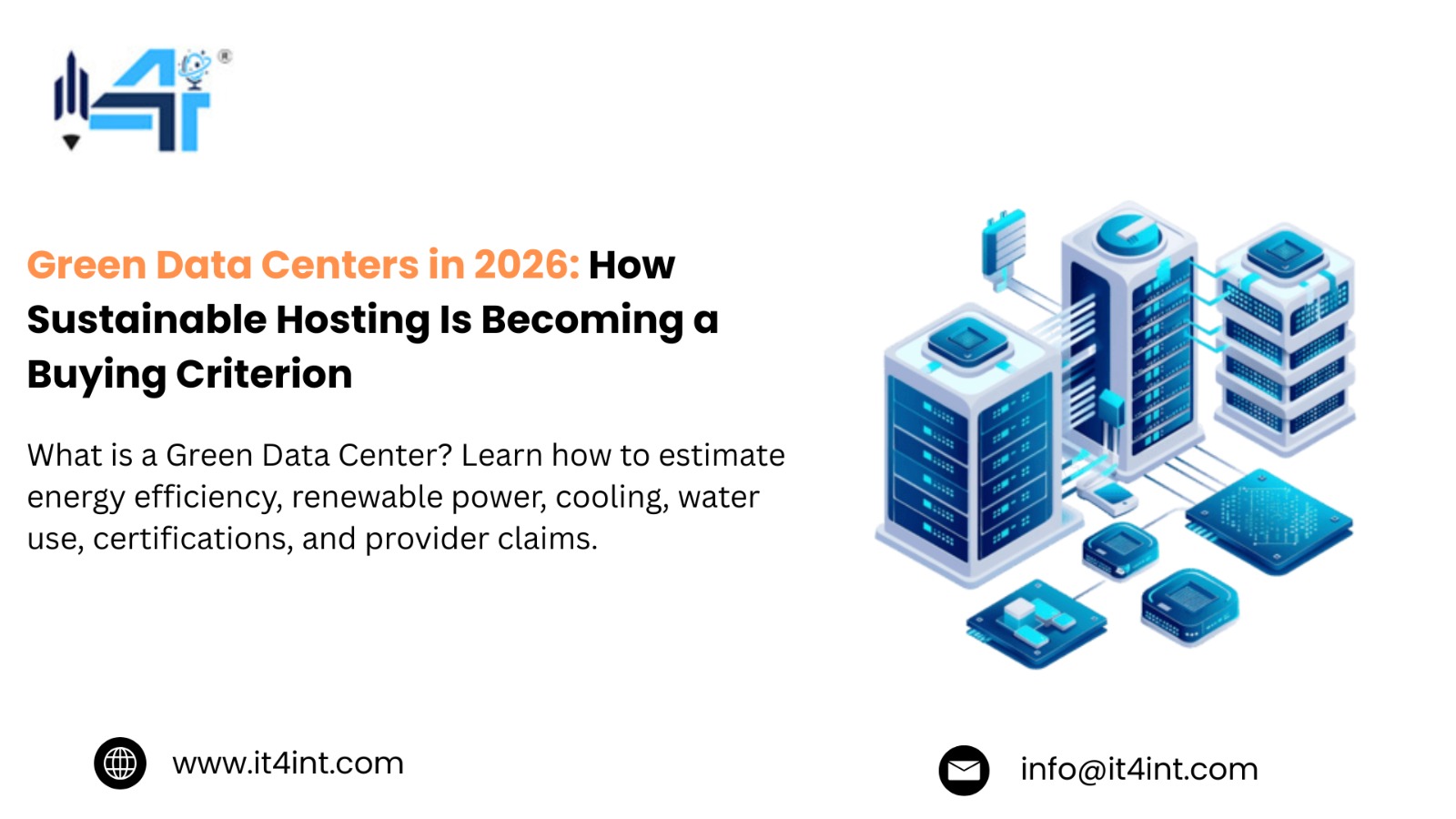
For a growing number of businesses, green data centers are no longer a sustainability talking point buried at the end of a vendor presentation. At the iT4iNT Server, we have seen that in 2026, sustainability stands as an important buying criterion, be it in RFPs, enterprise procurement conversations, client audits, or long-term infrastructure planning.
In fact, the biggest AI race will not be won by who has the most GPUs; rather, where will the power come from, and how efficiently can that power be used? Uptime, latency, security, capacity, and cost, all these data center conversations. Can it deliver reliable power for demanding workloads? Can it cool high-density GPU servers efficiently? Does it measure power usage effectiveness, water usage effectiveness, and carbon usage effectiveness? Is it a renewable energy strategy based on actual sourcing, contracts, or credible instruments, or is it relying on vague carbon-neutral language? And can these be independently evaluated by buyers?
That said, various providers can be legally compliant without being what you, as a buyer, would consider a genuinely sustainable facility. This is why this blog brings you all the answers as the green data center revolution moves from marketing language to operational reality. We will explore the technology, metrics, regulations, and questions that will help you set up your own green data center based on evidence rather than just branding.
What is a green data center?
Primarily, a data center can be powerful, highly available, and secure without necessarily being efficient. However, a green data center goes a step ahead, as it is designed and operated to reduce the energy, water, and carbon impact of digital infrastructure while maintaining the performance, resilience, and security businesses expect from their IT environment.
That being said, the difference between the two has become increasingly important as digital infrastructure expands. A green data center is designed and operated to reduce the environmental impact of digital infrastructure while still delivering the reliability, security, availability, and computing performance businesses need in 2026.
This means sustainability must be treated as a system, not just a slogan.
Here’s what a genuinely sustainable facility like iT4iNT Server looks like beyond a single metric:
⦁ Energy efficiency- We focus on reliable power delivery, where we can optimize your facility and IT energy efficiency
⦁ Water efficiency- Treated as a main cooling requirement, at iT4iNT Server’s green data center facility, water consumption becomes a measurable sustainability consideration
⦁ Carbon performance- While conventional reporting focuses on corporate-level carbon emissions, at our green data center we evaluate carbon impact alongside the facility’s energy use.
⦁ Cleaner power- Grid supply is the default in usual data centers; however, for green data centers, renewable and lower-carbon sourcing can form part of the strategy.
⦁ Efficient cooling- Cooling is usually designed around thermal requirements, but at our green data center, cooling is considered alongside density, performance, water, and energy usage needed for your facility.
⦁ Operational measurement-What makes iT4iNT Server’s sustainability claim of green data centers more reliable is that we provide you with your facility-specific measured performance rather than just broad corporate averages or future targets.
Moreover, a green data center is not just about solar panels, a carbon-neutral statement, or a low headline PUE. This means the shift from green claims to measurable infrastructure performance is what turns sustainability from a marketing statement into a procurement criterion.
Dedicated Server Plans
Power your growing business with IT4INT reliable infrastructure built for demanding workloads, with high performance, advanced security, and flexible configurations tailored to your needs.
Why is 2026 the inflection point?
Why 2026? Well, because this is the year when sustainability starts moving from a brand statement to an infrastructure buying criterion. AI needs more compute. More compute needs more electricity. Higher-density servers create more heat. More heat demands better cooling. This is what makes the green data center less of a future-facing concept and more of a practical infrastructure decision.
Here are the factors that are converting in 2026 for adaptation of a green data center:
⦁ AI is pushing power demand higher
⦁ Compute density is changing the infrastructure equation
⦁ Efficiency is becoming measurable
⦁ Sustainability expectations are entering procurement
⦁ Cooling is becoming a strategic decision
While 2026 is not necessarily the year every data center becomes green, it is the year buyers have fewer reasons to accept vague sustainability promises.
The buyer’s green data center checklist
As a business, choosing a green data center should not come down to a sustainability badge, a few renewable-energy claims, or the word “eco-friendly” on a sales page. Rather, the real test lies in whether your provider can show you measurable performance across energy, water, carbon, cooling, and power sourcing.
Here’s what to inquire about before signing a hosting, colocation, or infrastructure contract:
⦁ What is the facility-level PUE?
⦁ How much water does the cooling system use?
⦁ Do you measure carbon emissions?
⦁ Where does the electricity come from?
⦁ What cooling technology is deployed?
⦁ What power density can you support?
⦁ Can you provide facility-level data?
⦁ Which standards or certifications apply?
Additionally, the best infrastructure decision is not necessarily the provider with the most sustainability language. Green should be something your provider can demonstrate, not something you are expected to take on faith.
Read More : Do You Need a Bigger Server for Agentic AI Traffic in 2026?
Frequently Asked Questions
Conclusion
In conclusion, the green data center conversation has moved beyond sustainability reports. Especially in 2026, the fact that your infrastructure can deliver the performance you need without creating unnecessary energy, cooling, and environmental costs matters a lot.
Hence, the right data center is not the one that just calls itself green; rather, it is the one that can prove its infrastructure is built for efficiency, reliability, and the workloads of tomorrow, like iT4iNT Server.
CTA
Ready to choose infrastructure with more confidence?
Talk to the iT4iNT Server team about your workload and find the infrastructure setup that makes sense for your next stage of growth.