Ever since AI has evolved, the conversations have always centered on chips, larger models, and more powerful GPUs, but liquid-cooled data centers today are the real conversation at iT4iNT Servers.
Having said that, every breakthrough in AI, high-performance computing (HPC), scientific research, and advanced analytics generates something far less glamorous than innovation. This means modern GPUs are now consuming a kilowatt of power. And when dozens of them are packed into a single rack, it produces more heat than traditional air-cooled facilities. This marks a shift in how data centers are being built and expanded today. Be it the impact on performance, operating costs, energy efficiency, sustainability goals, hardware lifespan, or how much computing capacity your business can unlock without hitting thermal limits.
As an enterprise, hyperscaler, and colocation provider, iT4iNT Servers is increasing our investment in this space to provide modern organizations with an infrastructure fit for the future. For the same, let us learn how different cooling technologies actually work and why adoption is accelerating worldwide.
Is all liquid cooling the same?
Before we move on to understanding if all liquid cooling is the same, it is essential to know what liquid-cooled data centers are exactly. Primarily, it is a facility that uses liquid instead of air to remove heat from the servers, CPUs, GPUs, and other high-performance computing equipment. Liquid cooling allows heat to be transferred directly away from the components, which is more efficient.
While modern AI accelerators, high-performance computing (HPC) clusters, and next-generation GPUs generate a great amount of heat. Even though liquid cooling is used as a single technology, multiple cooling methods are designed to solve the same problem. The difference lies in factors like rack power density, workload type, facility design, budget, and future scalability. At iT4iNT, we view liquid cooling as a spectrum of solutions rather than a one-size-fits-all grade.
For the same, these are the three most widely adopted liquid cooling methods:
- Direct-to-chip (D2C) cooling
- Rear door heat exchangers (RDHx)
- Immersion cooling
Moreover, each of these solves the same challenge differently for organizations running moderate-density workloads, which may only need targeted chip-level cooling, while hyperscale AI environments pushing well beyond traditional rack densities often require more comprehensive thermal management.
Where does air cooling reach its physical limits?
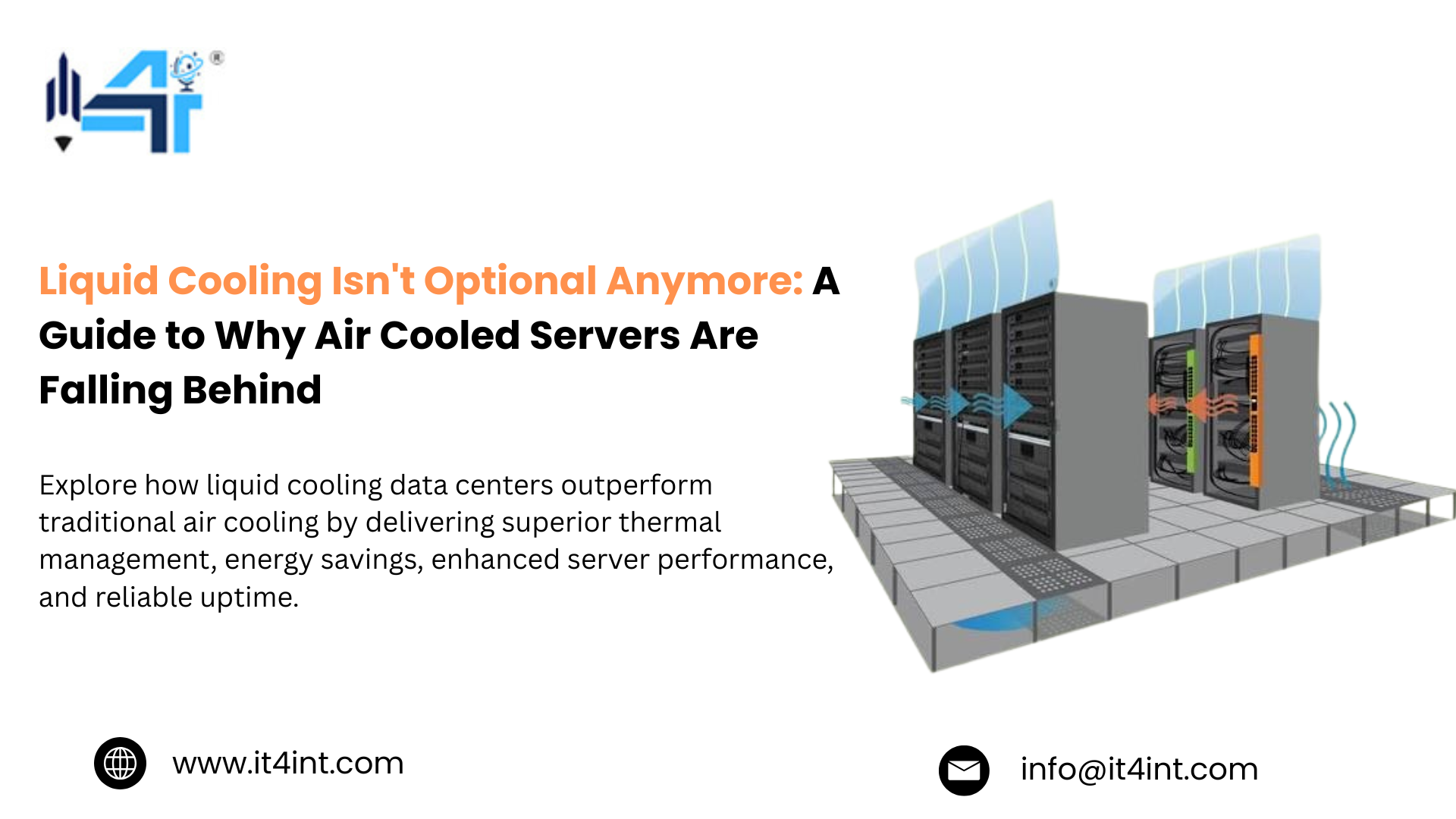
Behind the rise of liquid-cooling data centers is the limitation of air cooling, which kept enterprise applications running, supported cloud expansion, and evolved alongside increasingly powerful processors. However, as AI, high-performance computing, and GPU-intensive workloads increase, air cooling reaches its physical limits.
This is why at iT4iNT Servers, we make sure that your business does not reach a point where the heat is no longer being removed as the modern hardware generates it. Where today’s AI infrastructure frequently operates at 50-100kW per rack, here are some of the physical challenges of air cooling:
- Limited heat-carrying capacity
- Higher airflow creates diminishing returns
- Heat becomes unevenly distributed
- Thermal throttling reduces performance
In addition to this, air cooling has not just failed in certain conditions but has simply reached its design assumption limits. Especially when modern AI infrastructure generates heat that a conventional airflow was never intended to manage. That is where liquid cooling data centers are quietly replacing air cooling dependencies.
Why is cooling becoming a strategic investment?
Even though cooling was treated as a background utility, AI, HPC, cloud services, and data-intensive applications have raised rack densities, and cooling has become directly linked to business performance. We at iT4iNT Servers, have seen modern businesses consider cooling not just as an infrastructure but as a long-term investment that influences your venture’s scalability, operational efficiency, and competitive advantage.
Apart from that, multiple reasons have pushed cooling to become a strategic investment, which are:
- It unlocks greater compute density
- It reduces long-term operating costs
- It protects high-value hardware investments
- It supports sustainability objectives
- It enables future expansion
Moreover, the major change lies in how you evaluate your infrastructure decisions, where cooling is not just judged by installation costs but by its contribution to productivity, operational resilience, sustainability goals, and long-term scalability.
Are more data centers using liquid cooling?
Yes, today more and more data centers are using liquid cooling, even though just a few years ago liquid cooling was specifically linked to supercomputers and highly specialized research facilities. At iT4iNT Servers, we believe that this is not just the adoption of a new technology; rather, it is a response to a fundamental shift in computing requirements with the growth of AI and GPU-intensive computing.
Beyond that, here are a few more reasons why liquid cooling data centers are becoming a prime shift in this generation:
- Rack power density is rising
- Energy efficiency is becoming a priority
- Infrastructure planning is becoming more future-focused
- Enterprise AI adoption is expanding
- Sustainability goals are influencing investment decisions
In addition to these, the industry’s direction is also reflected by the market adoption, where a growing percentage of operators are already using liquid cooling in production environments, while many more are evaluating deployment as AI infrastructure scales globally over time.
Frequently Asked Questions:
Is liquid cooling only needed for AI and GPU workloads?
No, while AI training, machine learning, and GPU-intensive workloads are the primary drivers of liquid cooling adoption. The need for liquid cooling depends less on the industry you are in and more on the amount of heat your infrastructure generates.
Does liquid cooling mean my server is submerged in liquid?
Absolutely not. This is one of the most common misconceptions about liquid cooling. where immersion cooling is where servers are fully submerged in a non-conductive dielectric fluid; the most widely deployed solution today is direct-to-chip (D2C) cooling, where coolant flows through sealed cold plates attached directly to high-heat components.
How do I know if my workload needs liquid cooling?
The simplest indicator is power density. If your infrastructure consistently operates above 20–30 kW per rack, or you’re planning to deploy high-density GPU clusters for AI, HPC, or advanced analytics, it’s worth evaluating liquid cooling.
Visit – Dedicated Server USA, Dedicated Server India, Dedicated Server France, Dedicated Server Japan, Dedicated Server Italy, Dedicated Server UAE, Dedicated Server Spain, Dedicated Server Turkey